The Origins of News Literacy
- id: 1767456639
- Date: Jan. 5, 2026, 12:36 p.m.
- Author: Donald F. Elger
Goals
- Explain why News Literacy (NL) came into existence.
- Describe the rewards of learning NL
- Define NL.
The Origin Story
For most of human history (about 96%),1 people lived nomadic lives in small groups. Everyone knew everyone else. Trust was personal, direct, and based on lived experience. Tribes took care of each other.
About 12,000 years ago, agriculture emerged and people began living in larger, permanent communities. This created a new situation in which people could no longer keep track of what was going on simply by talking with members of their tribe.
In addition, a new problem appeared as people transitioned from small tribes to larger settlements: certain actors (groups and individuals) had incentives to skew the news to influence public opinion in their favor. These bad actors became increasingly effective at deception.
The history of news as a means of deception is rich with examples. Cigarette companies spread misinformation for many years to protect their profits. Drug manufacturers spread misinformation about opioids. The Nazis rallied their country to engage in World War II. In the United States, leaders used the news to garner public support for the war in Vietnam.
The Core Problem News Literacy Solves
Purposeful manipulation of the news by bad actors created a new problem: which news can we trust?
But the problem is bigger than intentional deception. The same highly effective methods used to spread deceptive news are also used by well-intentioned people who sincerely believe the news they are sharing is trustworthy, even when it is not.
As a result, deception in the news ecosystem does not require malicious intent. Honest actors can unknowingly propagate deceptive news simply by using persuasive and amplifying methods that work.
The Job of News Literacy
News Literacy was developed to solve this problem.
The job of this subject is to equip you to reliably get trustworthy news so that you are not deceived—either by bad actors who intend to mislead or by honest actors who unknowingly spread deceptive information.
Safe-News versus Unsafe-News
Safe-News is information about current events that is relevant to the public and meets standards of accuracy and fairness.
Unsafe-News is information about current events that may appear relevant to the public but does not meet standards of accuracy and fairness. It often looks like news and is taken to be news by many people.
To clarify this distinction, I will use a Venn diagram.
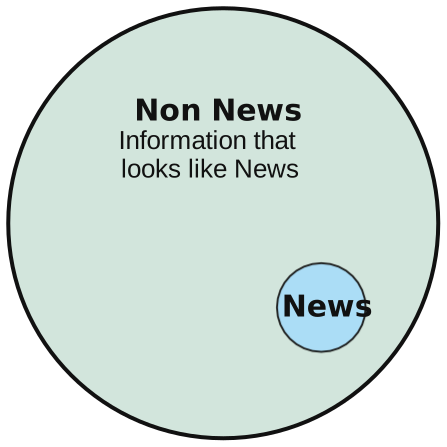
Both news and non-news share an important similarity: they provide information about current events that people care about.
The key difference is this. Safe-News is required to meet standards for accuracy and fairness. Unsafe-News is not required to meet any such standards.
Anyone who learns what these standards are can reliably distinguish Safe-News from Unsafe-News. These standards are not difficult to learn, but they are rarely taught, so most people are unaware that such standards even exist. In practice, accuracy and fairness are not black and white. Each exists on a continuum that ranges from low to high.
To explain why Unsafe-News is a serious problem, consider an analogy with water. Some water meets the standards for safe drinking water, but most does not. Water may be salty, contaminated, or polluted. Drinking unsafe water might cause only mild harm, or it might cause severe illness or death, depending on the level of contamination.
Unsafe-News is harmful in a similar way. The harm can range from mild to severe. The most dangerous aspect of Unsafe-News is that the harm is often not apparent to the person consuming it. Taking Unsafe-News into your brain is like ingesting a substance that causes harm over time, often without clear warning signs.
People consume Unsafe-News primarily because they have not yet learned how to tell the difference. This is like someone who drinks from any water source because they have not learned what makes water potable.
News literacy exists to solve this problem. Its purpose is to equip people to reliably identify both Safe-News and Unsafe-News.
Learning news literacy helps protect you and the people you care about. Encouraging others to learn it helps protect the larger community as well.
Success Criteria
Grok2 (deeply understand) Safe-News, Unsafe-News, and news literacy. Here are specifics relevant to this lesson.
- Explain why the subject of news-literacy was created.
- Explain why Unsafe-News exists.
- Explain why Unsafe-News is harmful.
- Explain why it is up to citizens to be skilled in news literacy (why we cannot rely on News Organizations, churches, the governments, Facebook, or anyone else)