Safe-News and Unsafe News
- id: 1746027383
- Date: Aug. 30, 2025, 12:26 p.m.
- Author: Donald F. Elger
Goals
- Describe News
- Classify News into Categories: Safe and Unsafe
- Get Safe News
- Reap the rewards of Save-News
What is News
News is timely information about current events that is relevant to the public and that meets standards of accuracy and balance.
Analysis of News: {Timely Information, Current Events, Public Interest, Meets Standards}
Current events refers to the topics such as world news, fashion, people, sports, weather, happenings, finance, politics, gardening, entertainment, wellness, climate, and so on.
But, most information that people consume and think of as “news” does not meet standards for accuracy and fairness. To address this problem, it is useful to define safe and unsafe news.
Safe-News versus Unsafe-News
Safe-News is information about current events that is relevant to the public and meets standards of accuracy and fairness.
Unsafe-News is information about current events that may appear relevant to the public but does not meet standards of accuracy and fairness. It often looks like news and is taken to be news by many people.
To clarify this distinction, I will use a Venn diagram.
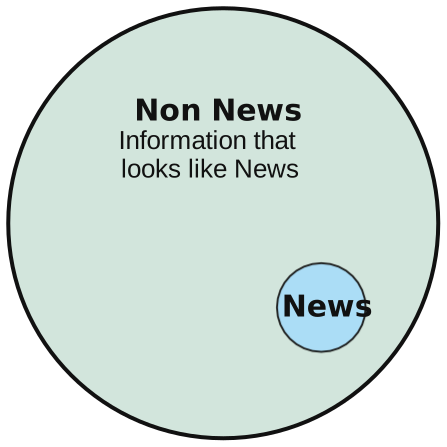
Both news and non-news share an important similarity: they provide information about current events that people care about.
The key difference is this. Safe-News is required to meet standards for accuracy and fairness. Unsafe-News is not required to meet any such standards.
Anyone who learns what these standards are can reliably distinguish Safe-News from Unsafe-News. These standards are not difficult to learn, but they are rarely taught, so most people are unaware that such standards even exist. In practice, accuracy and fairness are not black and white. Each exists on a continuum that ranges from low to high.
To explain why Unsafe-News is a serious problem, consider an analogy with water. Some water meets the standards for safe drinking water, but most does not. Water may be salty, contaminated, or polluted. Drinking unsafe water might cause only mild harm, or it might cause severe illness or death, depending on the level of contamination.
Unsafe-News is harmful in a similar way. The harm can range from mild to severe. The most dangerous aspect of Unsafe-News is that the harm is often not apparent to the person consuming it. Taking Unsafe-News into your brain is like ingesting a substance that causes harm over time, often without clear warning signs.
People consume Unsafe-News primarily because they have not yet learned how to tell the difference. This is like someone who drinks from any water source because they have not learned what makes water potable.
Unsafe news is not only “not safe,” it is also deceptive which means it tends to influence using techniques that are highly effective and nearly always hidden from their target. Thus, most people are deceived by Unsafe-News and they don’t realize it.
Unsafe-News spreads for two very different reasons:
Sometimes it is purposefully deceptive, spread by bad actors seeking power, profit, or influence.
More often, it is spread by well-intentioned people who sincerely believe they are sharing an accurate and fair view of reality.
However, the harm and deception are the same, regardless of intent because the influence mechanisms work whether or not the sender is acting in good faith.
Distinguishing Safe-News From Unsafe News
To tell if news is safe (trustworthy) or unsafe (deceptive), apply the Causal Model for news literacy.
The formula is straightforward and anyone can learn it.
Therefore, focusing on intent (bad vs good actors) does not solve the problem.
In some case, Unsafe-News is purposefully deceptive because a bad actor is striving to influence the public to achieve their ends. However, in most cases the spreaders of Unsafe-News believe that they are presenting an accurate and fair view of reality and they have good intentions. But the information has the same harm and deception.
News literacy exists to solve this problem. Its purpose is to equip people to reliably identify both Safe-News and Unsafe-News.
Learning news literacy helps protect you and the people you care about. Encouraging others to learn it helps protect the larger community as well.
- Current Events
-
This refers to topics of relevance: people, sports, weather, happenings, finance, politics, gardening, entertainment, wellness, climate, …
- Relevant to Public
- Standards of Accuracy and Balance
What is Not News
Not-News is relevant information about current events that does not meet standards of accuracy and balance; that is “Not-News” is flawed information.
To clarify, I’ll use a Venn diagram.
Analysis (Key Points)
- Relevant to the public.
- Covers many topics: sports, politics, local news, health, world
affairs, events, crime, and more.
- Timely—focused on what is happening now or very recently.
in brief (relevant, timely, many topics)
Sources of News
- Traditional media: CBS, NYT, Fox, WSJ, and so on.
- Social media: Facebook, Twitter
- Conversations: People chatting
- Citizen journalism
- News agencies: AP, Reuters
- Aggregators: Google News, Apple News, Microsoft Start (formerly MSN News), Yahoo News, and so on.
- Press releases by companies and non-profits
- Government agencies
Rationale (Why Care about News)
Summary: News currency equips you to take advantage of opportunities and respond effectively to threats.
- Civic Duty:
- Informed voting and participation in democracy.
- Holding power accountable.
- Personal Safety:
- Awareness of hazards: weather (hurricanes, etc.), food safety, and disease outbreaks.
- Understanding local safety concerns.
- Health Awareness:
- Disease outbreaks and health advisories.
- Medical advancements and health trends.
- Best diet and exercise.
- Economic Awareness:
- Financial decisions and economic trends.
- Business awareness.
- Global Understanding:
- World events and cultural awareness.
- Interconnectedness of the world.
- Other
- Know about upcoming events
- Learn
Skillful News (How To)
- Figure out what new categories matter to you.
- Universal Interest: topics every should stay current on:
- Particular Interest:
- Identify reliables news sources.
- Skim multiple of these sources. Strive for multiple source viewpoints.
- Triangulate which means to check them against each other.