Newton's Third Law of Motion
- id: 1756999887
- Date: Jan. 11, 2026, 5:28 p.m.
- Author: Donald F. Elger
Goals
- Explain this law.
- Skillfully apply it.
Statement
Newton’s Third Law: For every action, there is an equal and opposite reaction. More precisely: when one object exerts a force on a second object, the second object simultaneously exerts a force of equal magnitude but opposite direction on the first object. These paired forces act along the same line and always involve exactly two objects interacting with each other.
Examples
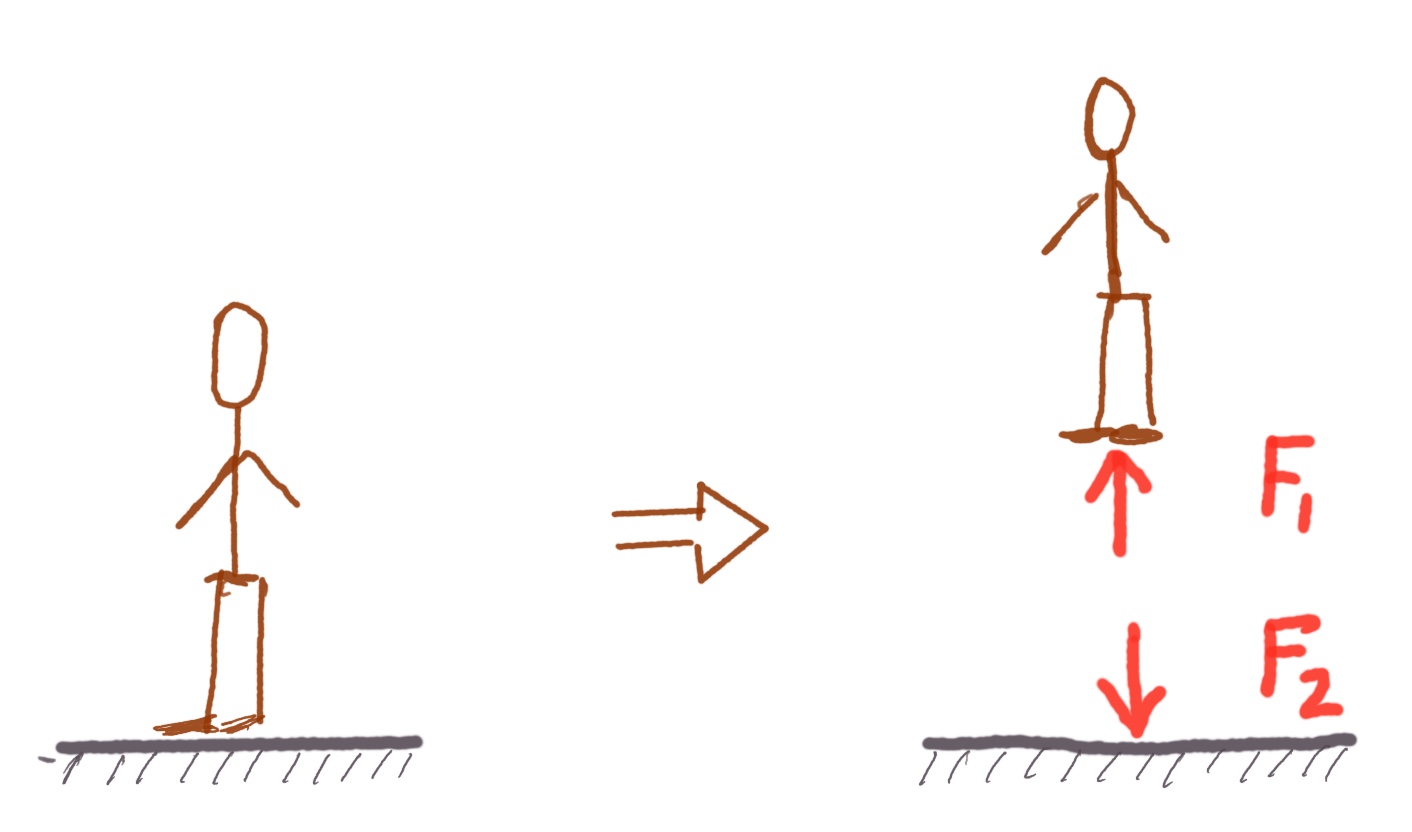
Person Standing
- Force 1: The person’s feet push downward on the floor.
- Force 2: The floor pushes upward on the feet.
- Vector: \(\mathbf{F}_1 = -
\mathbf{F}_2\)
- Visual (see below)
Weight of an Apple
- Force 1: The Earth pulls downward on the apple (gravity).
- Force 2: The apple pulls upward on the Earth with equal
magnitude.
- Vector: \(\mathbf{F}_1 = -
\mathbf{F}_2\)
- Visual (I will add a sketch)
Accelerating Car
- Force 1: The pavement pushes forward on the wheel through
friction.
- Force 2: The wheel pushes backward on the pavement with equal
force.
- Vector: \(\mathbf{F}_1 = -
\mathbf{F}_2\)
- Visual (I will add a sketch)